Have I changed? The late winter night when 9 white strangers stopped to help me.

12314447_10156247090050487_8001983955648414093_o

I feel that I need to share this story, especially given that I’ve shared stories of being in the UK and being ignored, or brushed off, by white folks. I’ve been brushed off so often in the past, that generally speaking, I’d stopped asking white people for directions at nighttime. However, the University term is just about over, and my views of Cambridge, England, and indeed ‘white people’, have undergone quite a notable shift. Throughout the entire term it’s been difficult for me to ignore that, generally speaking, white strangers have been treating me differently… and it has lead me to wonder: Have I changed? Is there something different about how I carry myself, or how I approach people, that has caused me to elicit many more positive encounters than I did before? There have been many examples over these past 2 months that have caused me to wonder what, if anything, has changed, but the following might just be the best example.
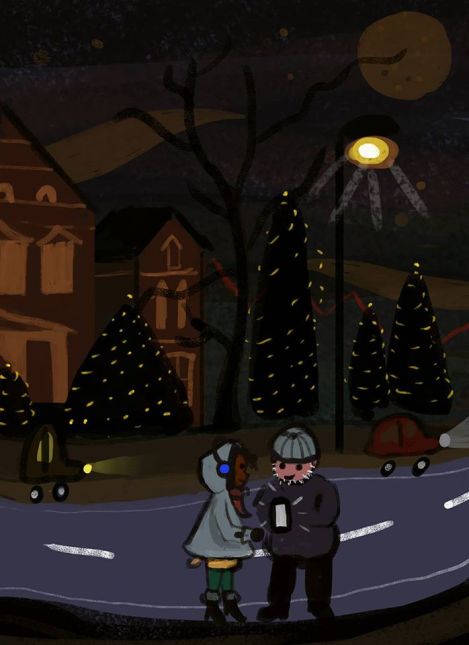
At around 10.30pm, one winter night last month, I got lost on my way to a function. I’d walked alongside a river, and then made a wrong turn up some stairs to the street, trying to find St. Edmund’s College. I approached nine white people on the street for directions that night, and they all stopped to help me. The first were two women with English accents. They seemed very happy to help. I’d asked if they knew where Magdelene College was, and St. Edmunds too, but they had no clue. However, wanting to help me out, they asked me if I knew what street it was close to. I said that it’s somewhere off Huntington Road, and they lit up. They began explaining how to get there and wished me all the best in finding the college. I told them thanks, and continued on my way. I was pleasantly surprised that they didn’t at all hesitate in helping me when I stopped them. I don’t think that I’ve ever had such a warm reception from white strangers when I asked for help at nighttime.
I was late for the function, and I was afraid of taking a wrong turn, but confident from my last encounter, I decided to stop someone else to ask for help. This next person I stopped was a white man (also with an English accent). He directed me as well, and I continued walking. By this point, I was thinking that perhaps I shouldn’t be so afraid to ask for help, and so I went along with that thought in mind. The walk was about 40 minutes, and there was ample opportunity for me to go off track. I next stopped a couple. They had foreign accents (perhaps Italian or Spanish) and although they didn’t know exactly where I was looking for, they stood for a little while trying to help. The most interesting encounter came next though. I stopped a middle-aged white man. He had an Eastern European accent. He also didn’t know how to find the college I was looking for, and I was about to say thanks and bid him farewell, but then he said ‘Wait!’ He pulled his phone out, smiled, and said ‘We’ll find it. I think it should be around somewhere.’ He started looking on Goggle Maps, but typed in the wrong search word. He didn’t seem to understand my accent very well, but he was very determined to help me figure out the directions to the college. We ended up searching on Google and getting directions for somewhere in Oxford. I felt like I was being a real hassle, and I said ‘It’s okay, thanks!’. He refused to give up though and I realized that he didn’t at all seem to mind going the extra mile to help me find the place. I honestly was very touched by how much he wanted to help. I stood there with him for minutes whilst I spelt things out and he searched on his phone. We eventually did find the directions and he happily exclaimed and smiled at me, “Yes!” It felt as though we had achieved something great together. His happiness and excitement at finding the directions to help me out was infectious. He then turned and started explaining the directions to me, said that he’s sure that I’ll find it and won’t get lost again, and wished me the best. He was so happy about it that I felt like I was the one helping him out. I thanked him, wished him the best too, and carried on. The last group I stopped on the street was a group of young women (English accents, teens/early 20s). They stood for a while, speaking to me and amongst themselves, trying to help me figure out where to go. They said that they knew I was close to the college, but they weren’t sure where exactly the building was, and so they directed me to a porter’s lodge a few minutes away where they were certain I’d be able to get help. Shortly after meeting them, actually, within about two minutes, I found St. Edmund’s college.
I know this might sound cheesy, but my eyes are actually watering writing this. I was just so happy. It was such a beautiful night. I’d met such amazingly helpful people during the walk that the journey to the function was as much a ‘main event’. It’s so easy to give up hope after a few negative experiences, but that night I became fully convinced that it’s worth it to not give up too soon when forming an opinion about entire groups of people.

Why a ‘black James Bond’ can’t be compared to a ‘white Egyptian Pharaoh’

12249946_10156197642070487_7763617612868439342_n

One poster for the upcoming film ‘Gods of Egypt’.

Whenever Hollywood releases an epic film set in Egypt and they cast powerful people, or beings, as white, there is outcry against the whitewashing…. and to counter that outcry, there are often the folks who say: “Well, it’s just fiction”, or “Well, you won’t complain if they want to cast James Bond or Thor as a black guy”. 
They’re right; I won’t complain if they decided to cast James Bond as a black guy, or Thor as a muscular, dark-skinned, Kenyan man with flowing black dreadlocks and a Japanese accent. Expecting ‘I will complain’, is an expectation based on the idea that my reasons for being opposed to the whitewashing of Egypt are solely related to ‘historical, and other, accuracy’. However, they’re not–not exactly.
I complain because in a context where black people are so often represented as ‘less than’ or not represented at all; in a context where non-white actors struggle to find great film roles; in a context where ‘white is alright’ and so few people know of black achievement and invention culturally, historically, scientifically, socially, it sucks to have one of the historical greats of African culture glossed over and made ‘white’ so consistently; like so much of the glorified ‘everything’ around this world is. In a different context, one where Africa is celebrated and broadcasted as diverse and beautiful, one where the first thing that comes to mind when you hear ‘Africa’, isn’t ‘poverty’, one where there is great celebration and appreciation of the historic (and other) contribution of non-Europeans, then it won’t be such a bad thing to be imaginative and cast Pharaoh as a blond, white guy with an English accent. It might actually be something fun or cool. However, when a community is already looked down upon or ignored, or has had so much of their culture and achievement erased, it’s just kicking folks when they’re down to then go and replace alongside the erasure. Casting a black James Bond isn’t nearly as ‘dangerous’ to the development of positive ideas surrounding ‘whiteness’ because we live in a world where Europe, and especially England, is celebrated. Casting one black James Bond in a sea of white James isn’t going to strengthen any perception that ‘European achievement is solely related to the black folks in Europe’ because no such narrative exists. However, casting white Egyptian gods, in a sea of powerful white Egyptians in films past, strengthens the existing perception that ‘African achievement is solely related to white folks’ presence in Africa’.
We’re not yet living in a world where Africa is celebrated or appreciated in film, and otherwise… and until we live in such a world, I can’t support ‘creative freedoms’ that take the opportunity to erase and replace African peoples’ glory rather than celebrate it.
As an artist, or creative, I’m for imagination, and fantasy, and expression… it’s a beautiful thing when we can suspend reality for a moment, within reason. However, we always need to be aware that films aren’t just a way of escaping reality, but of shaping it as well. As artists, our contribution, and I dare say ‘responsibility’, is to help people to escape and cope with the dreariness of everyday life… both in the fantastical world of imagination, and in the actual world of reality. When we make films and stories that consistently refuse to acknowledge and celebrate the beauty of a people, we’re shaping their reality negatively; we’re enforcing and encouraging the perception, the idea, that a certain group of people have nothing to be proud of. It’s a wrong idea, and a destructive one too.
In my mind, there are two ways to fight the problem… one is making films that celebrate human diversity, and the other is boycotting and critiquing those that don’t. Right now, I’m boycotting and critiquing those that don’t, and well, amongst the many things I hope to do before I die, I’d hope to direct or help finance film that celebrates and acknowledges the beauty and greatness of black people… we need to see more of that.

———————————

Note/Response to question on the above:
1. I like to think that we can expect white people in powerful positions (be they University presidents and chancellors, company executives or politicians) to not promote or support racism; and so I won’t ever encourage people to give up all hope that Hollywood or other powerful institutions can change. Hollywood certainly has changed in the past, very slowly, but it has, and I have no reason to believe that progress won’t happen in the future with continued pressure and critique. The real issue isn’t just money, it’s also about reaching to a place of celebrating the equal humanity and dignity of others. We don’t need a situation where we have ‘black film that black folks watch’, or universities with just rich white people that teach their white students that white alone is alright, we don’t need insular bubbles, we need a situation where we have diverse film, diverse teaching, messages that celebrate everyone that everyone watches— because we all live together. Throwing money at building up one population, whilst ignoring the damaging messages being fed to another, is a recipe for bubbles of hate, misunderstanding and conflict. Money in the wrong hands, without appreciating the need for diversity when the audience is diverse (or even when it isn’t), might only result in segregation and hate. We need to push for understanding alongside everything else. But beyond that, I already noted that there are 2 solutions to the problem– one being boycotting (which hurts financially) and critiquing (which justifies why the boycotting comes from a place of genuine concern for humanity, rather than hatred) and the second solution being making films that celebrate the diversity we want to see celebrated— something I hope to do. I’m not at all sure how I’m supposed to read your suggestion to approaching Creflo Dollar, so I’ll hold back on a response to it. Either way, never will I be the person who says that Africans shouldn’t expect good from anyone else because: white leaders/people won’t change, Indian leaders/people won’t change, Chinese leaders/people won’t change—they’re all just selfish and inconsiderate, so let’s completely ignore them and their potential role in trying to make a better world and tell people that the only solution is to fend for themselves since everyone else is inherently ‘bad’. If ever I’m in a position of great power, I’d hate to think that any group of people would simply assume that I’m racist, selfish and inconsiderate and hence don’t try to get me to change whatever destructive thing I might be doing. I happen to believe that there is a place for everyone to contribute to each other’s development, and I happen to believe that we all have a part to play, and that to some extent we have (or can have with sustained pressure) some inclination to play that part— so despite your order to ‘Stop’, I’ll continue to push for change both by encouraging those with the most power now to do something, and also by encouraging those who more immediately need change to do what they can themselves.


My Teachers from secondary school to University

12301674_10156215733295487_2924140590034869118_n

These are 4 of the 6 acrylic on canvas board paintings I’ve done, since secondary school, of teachers who’ve made a big impact on my life (There are two other teachers, but I haven’t yet re-found my pictures of the paintings). I have tended to feel rather guilty about posting these paintings, and so I have, in the past, waited quite long before ever showing them on Facebook; because it feels like ‘showing off’, and I don’t want to be seen as though I’ve only painted for the sake of showing off. I feel doubly guilty now because I actually do have to ‘show off’ rather consistently these days to attract jobs, so I feel less innocent in sharing art. Either way, the first one (Mrs. Benjamin) was done and given when I was a teenager, then there was Prof. Chadee and David. The latest (John) is from this year. I’m always disappointed with the quality of the paintings I do on canvas…. they’re never as polished as my digital paintings, which sucks because they’re usually the most personal; they’re often the work that I want to reflect my very best since they’re usually gifts to say ‘thank you!’. But the gradients are never as smooth as I can get them when painting on a computer, and it’s overall never as perfect as I’d want it to be. However, because I often pour the most into them, they’re the most meaningful to me… and well, I guess, as a bonus, I think that I’ve certainly improved, ability-wise, using an actual paintbrush, across time.
Related video, about my paintings, here: https://www.facebook.com/Jendayi.r.a/videos/10156215537895487/?pnref=story

My Grandpa’s jacket and the MV Empire Windrush

12294675_10156210747790487_3801853358522684327_n

I visited my grandpa just before I flew to England in September. We sat downstairs at his Chaguanas home and I gave him the Hong Wing coffee and dried channa he’d asked me to buy on my way to visit him. After a bit of small talk, and eating, he asked me about my plans to go study at Cambridge… and our conversation gradually moved into what it’s like to live in England. It was at that point that he shared a story with me that I’d not heard before.

He told me that many years ago, in the 1950s, when he was around my age, he’d wanted to go to England. Whilst he can’t quite recall the name of the ship, he later said it was probably the MV Empire Windrush. At the time, that ship travelled a route between the Caribbean and the UK, and many Caribbean natives left on her to make their way to England. He’d hoped to be one of those people, but things didn’t go as planned. He told me of how he’d planned and saved up enough money for the trip, and how his brother had already gone before. The only thing he had left on the list of things needed for the trip was a jacket, which would have cost him $100, but he couldn’t afford it. He tried to get help from his father to pay for a jacket, but his father refused to support him and criticized his ambitions to go to England by saying that he’d only end up doing menial and demeaning jobs at the feet of English people. Dismayed, grandpa gave up on his dreams of going to England, and he’s never made the journey.

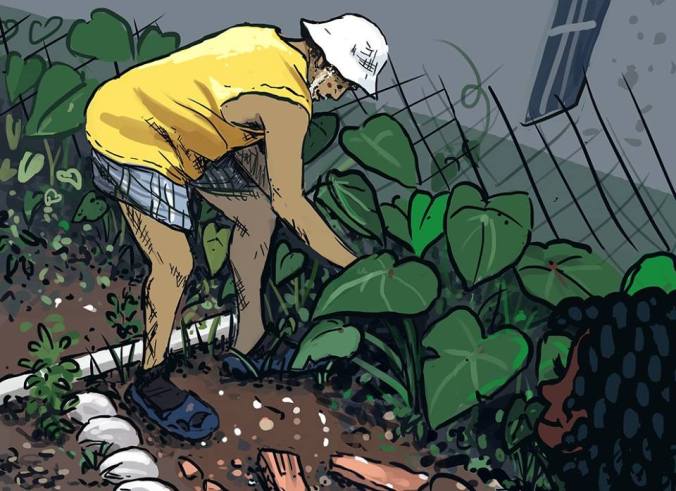
We didn’t spend much time talking about him giving up on that dream, since shortly after he changed the topic. He told me that he wanted to pick some dasheen bush to give me to carry home to cook.

The story stuck with me though… it struck a cord, because two years ago, when I first made a journey to the UK, grandpa gifted me a jacket. I’d not thought much of any meaning behind the gift then, but having heard grandpa’s story about needing a jacket for his journey in the 1950s,it made me appreciate that the jacket he gave me wasn’t ‘just’ an article of clothing, but in a special way it was him facilitating my experience of the dream he wasn’t able to.

Grandpa picked the dasheen bush, and we continued to talk. His neighbor joined in the discussion too. We spoke about seeing the world, good coconut pone, and cake. Before I left, grandpa wished me well, and so did his neighbor. He hugged me and blessed me for the journey ahead. I said thanks, wished him well too, and even more than I ever did before, appreciated that he believed in me, wished me to enjoy the experiences he never had and to journey further than he ever did.

Profiled at the airport and the importance of meeting counter-examples

12294758_10156206762160487_3218207825391493377_n

I recently heard of 2 incidents involving Southwest Airlines in the US, where people perceived to be of Arabic descent faced being kicked off a flight because a few passengers were supposedly afraid of them. In one incident some passengers stood up and defended the Arabs’ right to fly, whilst a few others complained that they shouldn’t be let on the plane. Those passengers who defended the Arabs knew that it’s not right to limit someone’s freedoms simply based on broad stereotypes. The passengers who stood up for the Arab folks showed them that ‘not all non-Arab Americans think ethnic Arabs should be discriminated against’. They perhaps eased some of the hurt the Arabs felt. They perhaps stopped the Arab folks from developing some implicit sense of reactive hate; they perhaps stopped them from beginning to develop broad stereotypes of non-Arab Americans as ‘bigoted haters’. In the second incident however, the Arabs were kicked off. I’d not be surprised if the Arabs in the second story momentarily felt more of a sense of ‘well now I hate ‘them’ too’, than the Arabs in the first story. Our reaction to hate is usually to hate the haters. It takes restraint to respond to hate with love and without making sweeping generalizations about ‘them’.
Sometimes however, often times perhaps, profiling isn’t so clear-cut. We’re often unsure of whether or not a particular incident we’ve faced was grounded in ‘racism’ or ‘randomness’.
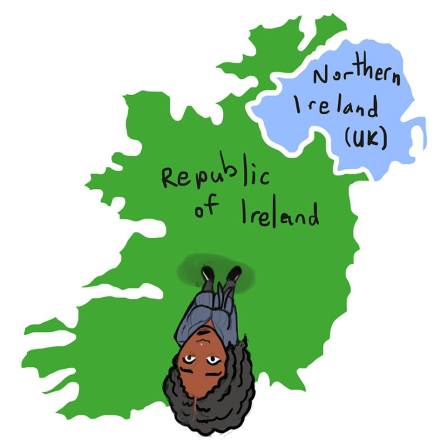
I have tried to assume that when I have encountered extra checks that profiling didn’t play a part. On two occasions, when travelling with white European folks, I was stopped and checked further whilst it appeared that everyone else was let through without hassle. I didn’t make much of it the first time; the airport woman who stopped me, when I was leaving England for Italy, said that I was just randomly selected to go through an extra search. I believed her. The second time I was stopped though, I felt a bit embarrassed, stupid and as though something was wrong with me. I had just arrived in the Republic of Ireland, from England, with David (he is white and English). Everything went smoothly up until the point that we got to the immigration officer. I had my passport in hand. Beyond that though, I had my student visa for the UK: which explained why I was in England for so long previously. The Republic of Ireland, and Northern Ireland are two different countries, but they share the same island. Northern Ireland is part of the UK (alongside England, Wales and Scotland), but the Republic of Ireland is not. However, Trinis can visit all, without a visa, for 3 months. So I figured that my passport would have been enough. The officer looked at David’s passport and simply let him through. Another officer looked through my passport and then he began questioning me. He asked when I was going to leave the Republic of Ireland. I think I said that I was only going to be there for 4 days as a vacation, and then I was going to head to Northern Ireland (which is part of the UK) before heading back to England (which is also part of the UK). I had no proof of when I was going to leave the Republic of Ireland, but I had a plane ticket for when I was going to leave Northern Ireland. David had my ticket in his bag, and he’d already walked out, so I told the officer that the printout of my ticket was in David’s bag. So I motioned to David to walk back through, and he did. I told him that the officer wanted to see my ticket. The officer seemed more at ease when he realized that David and I were together. David dug through his bag and pulled out the ticket showing that I was going to leave Northern Ireland, and he spoke a bit about how we’re there on vacation. The officer was then satisfied, seemed relaxed, and he let me carry on through. I felt really stupid, and nervous, as we walked out the airport. I kept thinking: “You were dumb to not have your ticket in your hand. You shouldn’t have needed David to put the officer at ease”.
I moved from the Republic of Ireland to Northern Ireland (the UK) by train, without the slightest of security or passport checks. Either way, I never quite came to a conclusion that I was profiled… I just walked away from both incidents feeling like I was unlucky and stupid. Perhaps it was the wrong way to feel (or not), but it’s how I felt. Since then, I’ve travelled with every document I thought I might possibly be asked about, in an envelope, and on hand. I’ve never needed them all though, but it’s made me feel safe from having to feel stupid again. I have met really lovely airport immigration officials in the UK though… enough nice ones who strike up small talk about Trinidad and studying, or who let me through without checking– even when I do go to the ‘Things to declare’ line. So, I don’t harbor any particularly strong feelings that ‘‘they’ hate me’. It’s all made me aware not necessarily of whether or not a profiling problem exists (because I believe one does), but of the importance of having positive experiences with people perceived as ‘other’. Had I not met the lovely airport officials that I did meet on other occasions, I might have walked away with only the view that I was perceived by all as somehow ‘bad’, ‘suspicious’ and/or ‘unworthy’.